

Independence Shouldn't End When Illness Begins

For more than 35 years, kidney disease has been my constant companion. It has taken me through in-center hemodialysis, peritoneal dialysis, kidney transplantation, transplant loss, and today, home hemodialysis. Along the way, it also gave me a purpose: helping others navigate their own kidney journeys.
For decades, I have encouraged other patients to consider home dialysis because I know firsthand the freedom, flexibility, and independence it can provide. I still believe it is one of the greatest advances in kidney care. But my own journey taught me something equally important: even the most independent patients sometimes need temporary help.
That lesson came during one of the most frightening experiences of my life.
Several years ago, I
developed a serious MRSA infection. At first, I thought I was simply
exhausted. Then came the fever. My hip hurt. Then my shoulder. My
strength disappeared, and my thinking became cloudy. I had performed
home dialysis independently for years, yet one day I suddenly
couldn't remember how to set up my dialysis machine.
I had performed
home dialysis independently for years, yet one day I suddenly
couldn't remember how to set up my dialysis machine.
My mother immediately realized something was terribly wrong. She called my sister and my daughter, and together they rushed me to the hospital.
That decision likely saved my life.
Doctors discovered that the infection had spread into both my hip and shoulder joints. I underwent surgery to remove the infection, followed by weeks in the hospital and rehabilitation during the height of the COVID-19 pandemic.
When I was finally able to return home, the recovery was far from over. I was still receiving intravenous antibiotics, but I was determined to remain on home dialysis if at all possible. I learned to administer my own IV antibiotics at home—a responsibility that required careful training and commitment. Had I not been willing and able to do that, I would have had to return to in-center dialysis simply so the antibiotics could be administered after each treatment.

Even with that determination, I was still too weak to perform my dialysis treatments independently.
There was no temporary assistance available to help me continue dialysis safely at home while I regained my strength. Instead, I eventually had to return to in-center dialysis until I recovered enough to resume home hemodialysis on my own.
I promised myself I never wanted to experience that again. Then life surprised me once more.
Last year, I received the phone call every transplant patient dreams about. A donor kidney had become available. After years of waiting, I believed I was finally getting another chance.
Instead, I experienced another heartbreaking disappointment. During surgery, my transplant team discovered that my blood vessels had become too calcified to safely connect the kidney. The transplant could not be completed. In a matter of hours, I went from imagining life with a functioning transplant to waking up knowing I would still depend on dialysis.
I returned home emotionally devastated and physically exhausted. Once again, I was too weak to perform my home dialysis treatments on my own.
This time, I was determined not to lose the independence I had worked so hard to regain. I used my personal savings to hire dialysis technicians to come into my home and assist me with my treatments while I recovered.
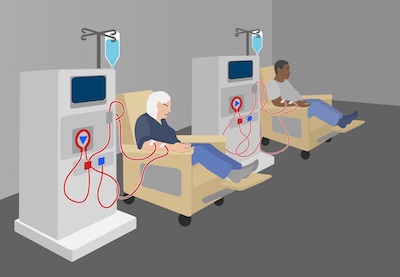
Every treatment cost money. Every week my savings became smaller. I was not paying for convenience. I was paying for the opportunity to stay on the therapy that had given me my independence and my quality of life.
I hoped I could afford that help long enough to recover. Eventually, my savings ran out, and despite doing everything I could, I was forced to return to in-center dialysis
until I was physically able to perform home hemodialysis independently once again.
Having lived through this experience twice fundamentally changed how I think about home dialysis policy.
We celebrate patient independence, and we should. Home dialysis empowers patients to become active participants in their own care. But independence should never mean facing a temporary medical crisis without support.
No patient should have to spend their life savings simply to remain on home dialysis during a short-term illness or recovery. No patient should lose the therapy that provides them the greatest quality of life because temporary assistance is unavailable.
That is why I strongly support the Improving Home Dialysis Act of 2026 (H.R. 8875).

Among its provisions, the legislation would establish limited staff-assisted respite care for home dialysis patients who are temporarily unable to perform treatments because of a physical limitation, while also expanding access to short-term mental health services for individuals beginning home dialysis. These are targeted, temporary supports designed to help patients remain safely at home during vulnerable periods—not permanent services.
I have spent much of my life advocating for kidney patients. I have worked alongside healthcare professionals, researchers, policymakers, and patient organizations to improve kidney care and expand opportunities for people living with kidney disease.
But this issue is not just professional for me.
It is deeply personal.
I have lived it.
Twice.
I was fortunate enough to find my way back to home dialysis after both experiences. Many patients never do.
I hope I never face those circumstances again.
But hope is not a healthcare policy.
Home dialysis gives patients their wings back. We
should not allow a temporary illness to take those wings
away. 
Every patient who chooses home dialysis deserves the opportunity to remain safely at home during life's most difficult moments—not because they can afford to pay for help, but because preserving independence is an essential part of high-quality kidney care.
That is why I support the Improving Home Dialysis Act of 2026. I hope you will too.
Comments
Glenda V. Roberts
Jul 21, 2026 5:06 AM